Go Back
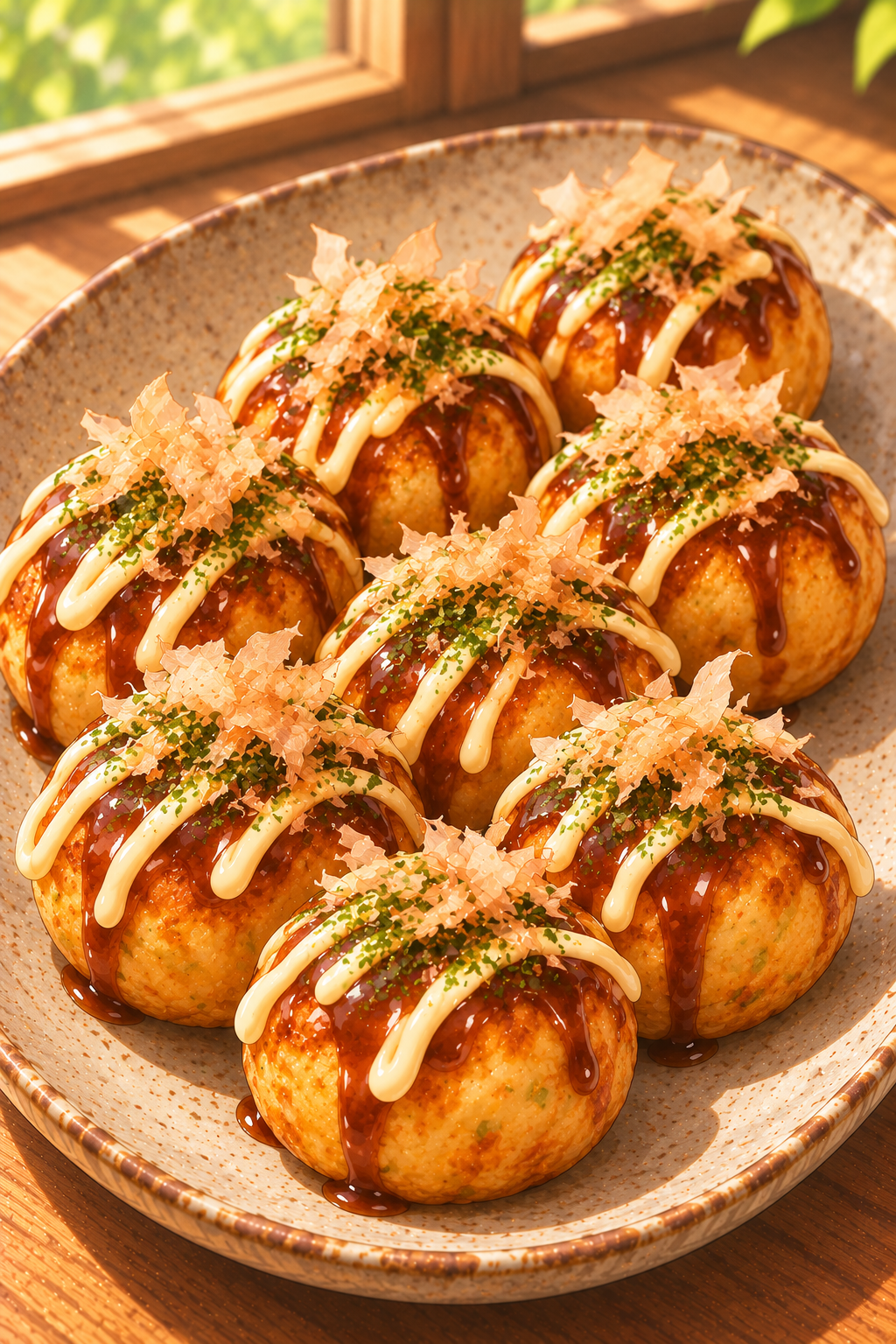
Close-up anime-style illustration of eight golden-brown takoyaki topped with glossy sweet-savory sauce, Japanese mayonnaise, crushed aonori, and delicate bonito flakes.
Hidden Flavours Village

Koro-Sensei-Inspired Takoyaki (Japanese Octopus Balls)

Golden Japanese takoyaki filled with precooked octopus, scallions, and pickled ginger, topped with takoyaki sauce, Japanese mayonnaise, aonori, and bonito flakes. An unofficial Assassination Classroom-inspired snack.
Prep Time 20 minutes
Cook Time 25 minutes
Total Time 45 minutes
Servings: 4 servings
Course: Snack
Cuisine: Japanese

Ingredients
  

For the batter
  • 1 1/4 cups all-purpose flour about 150 g
  • 2 tbsp cornstarch about 16 g; for a tender texture
  • 1/2 tsp baking powder
  • 2 large eggs
  • 1 2/3 cups dashi stock about 400 ml; prepared and cooled; unsalted or lightly salted
  • 2 tsp low-sodium soy sauce
For the filling
  • 5 oz precooked octopus about 140 g; cut into 24 bite-size pieces
  • 3 scallions finely sliced
  • 2 tbsp red pickled ginger (beni shoga) finely chopped and drained
  • 2 tbsp tenkasu tempura bits|optional; omit if unavailable
For cooking and serving
  • 2 tbsp neutral cooking oil approximately; to brush the wells and pan surface adding more if needed
  • 1/4 cup takoyaki sauce 4 tbsp; for drizzling
  • 3 tbsp prepared Japanese mayonnaise for drizzling
  • 1 tsp aonori dried green seaweed for sprinkling
  • 2 tbsp bonito flakes katsuobushi loosely packed; for sprinkling

Method
 

  1. Prepare the fillings. Cut the precooked octopus into 24 small pieces. Finely slice the scallions, and chop and drain the pickled ginger. Measure the sauce, mayonnaise, aonori, and bonito flakes so they are ready for serving. Use precooked octopus, not raw octopus, for these short-cooking takoyaki.
  2. Whisk the batter. In a large bowl whisk together the flour, cornstarch, and baking powder. In a separate container whisk the eggs, cooled dashi, and soy sauce. Gradually pour the wet mixture into the dry ingredients, whisking until pourable and mostly smooth. The batter should be noticeably thinner than pancake batter; stir before every batch because the starch settles.
  3. Preheat and oil the pan. Heat a takoyaki pan over medium heat according to its instructions. Brush each well and the surrounding flat surface generously with neutral oil. Set the pan on a stable, heat-safe surface. The oil helps prevent sticking and promotes a golden outside.
  4. Fill the wells. Pour batter nearly to the top of each well. Add one piece of octopus, a pinch of scallions, a little pickled ginger, and, if using, a few tenkasu bits to each. Top up with a little batter if needed. Keep the add-ins small enough to fit inside a rounded ball.
  5. Turn and cook the takoyaki. As the edges begin to firm, use takoyaki picks or wooden skewers to loosen the batter around each well. Rotate each piece about a quarter-turn, tucking the soft edges underneath. Continue turning and rounding the balls until the surfaces are golden and the egg-containing centers are cooked through, not liquid. Allow roughly 6–8 minutes per batch, adjusting for the size of the wells and the heat of the pan. Repeat with the remaining batter and filling. A 12-well pan usually needs two batches; timing varies. For egg dishes, a safe benchmark is 160°F (71°C) at the center if a thin food thermometer can be used.
  6. Sauce and serve. Transfer the cooked takoyaki to plates, about six balls per person. Drizzle with takoyaki sauce and Japanese mayonnaise. Sprinkle with aonori and bonito flakes. Allow the centers to cool briefly before eating. Sauce just before eating; the centers retain heat and can burn the mouth.
Notes

  • Makes approximately 24 takoyaki, or four snack servings of six. The exact number depends on the size of your takoyaki pan.
  • Plan for about 20 minutes of preparation and 25 minutes of cooking, including preheating and multiple batches; the full recipe takes about 45 minutes.
  • A takoyaki pan is required to make the traditional round shape. Keep the batter thin and stir it before each batch.
  • Use cooked octopus and refrigerated, prepared Japanese mayonnaise. Cook the egg-based batter fully; it should be soft but not raw or runny in the center.
  • Contains wheat, egg, soy, and molluscan seafood (octopus); dashi and bonito may contain fish. Check commercial sauces, mayonnaise, and tenkasu for additional allergens.
  • Refrigerate perishable leftovers within 2 hours; reheat leftovers to 165°F (74°C) and add fresh toppings after reheating.